
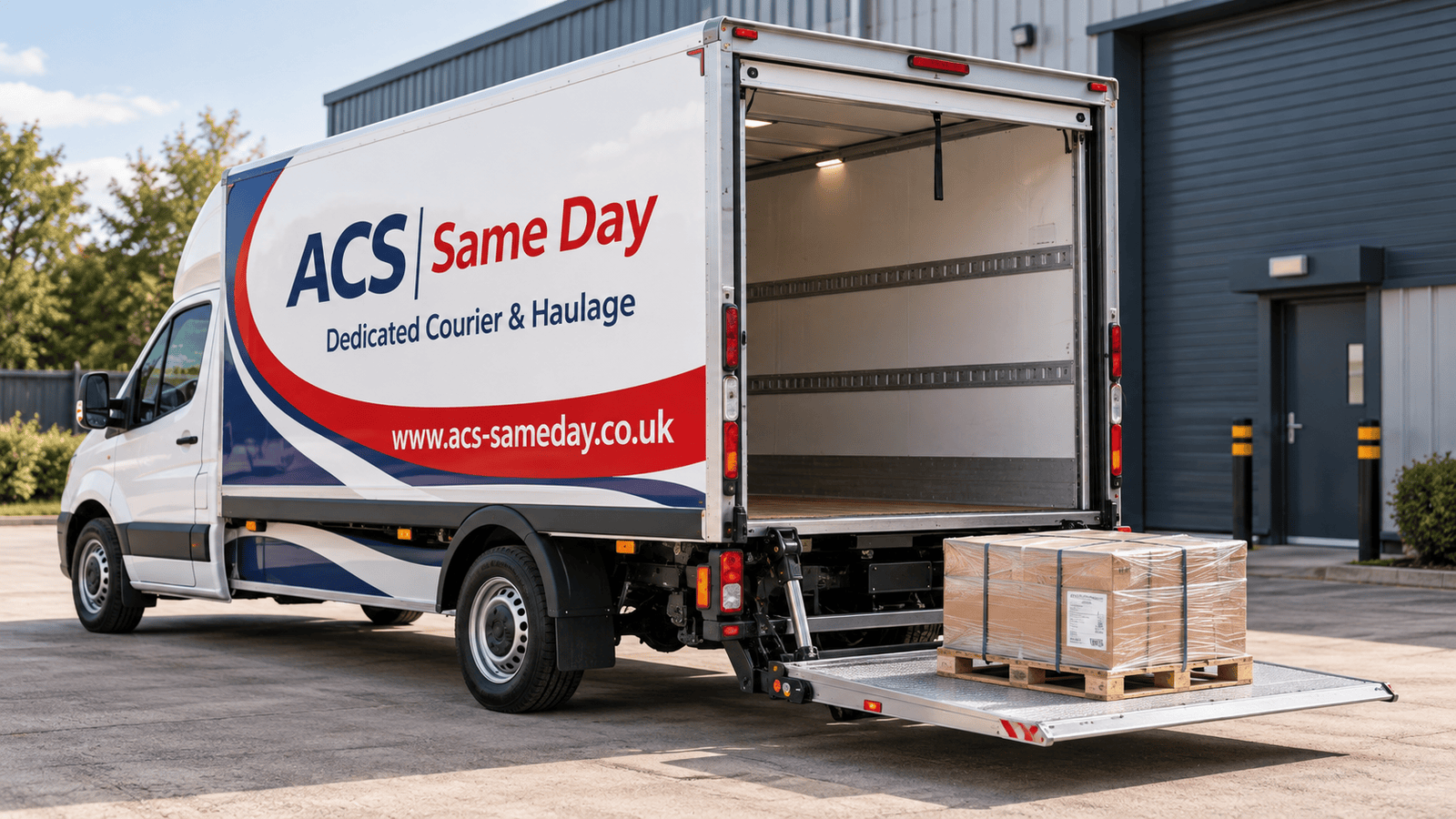
Start with loading and unloading
You may need a tail-lift courier when palletised or bulky goods must move between ground level and a vehicle, and there is no suitable forklift or loading bay at one of the addresses. Check the goods and the loading facilities at both addresses before choosing a vehicle.
A pallet fitting inside a van does not mean it can be unloaded when it arrives. Before booking, agree how the goods will get on and off the vehicle, who will receive them and where they can safely be placed.
What does a tail lift do?
A tail lift is a powered platform fitted to the rear of a vehicle. It raises or lowers suitable goods between the vehicle floor and ground level. For a pallet delivery, you may also need a suitable pallet truck.
It is not a crane, and it does not make every delivery point accessible. Lowering a pallet to the ground is a separate task from moving it across a yard, through a doorway or into a building.
Check the facilities at both addresses
Ask the sender and receiver separately about loading equipment. A warehouse may have a forklift at collection while the delivery address is a workshop with no mechanical unloading equipment. You’ll need a vehicle that can unload at the workshop.
- Is suitable equipment available at the actual collection or delivery time?
- Can it reach the goods on the proposed vehicle?
- Will an authorised person be there to operate it?
- Is rear unloading possible, or must the goods be accessed from the side?
- Where will the goods be left after unloading?
“Forklift available” is not enough if its operator leaves before the vehicle arrives. Equally, a loading bay should not be assumed compatible with every van or truck.
Tail-lift capacity and vehicle payload are different limits
The weight of each pallet or handling unit matters, as well as the total shipment weight. Include the pallet and packaging, rather than using the weight of the goods alone.
ACS tail-lift limits are 400 kg per pallet or handling unit for Luton vans and 1,000 kg for suitable tail-lift-equipped HGVs, subject to availability, load suitability and site conditions. Total vehicle payload limits also apply. See our vehicle and loading guide for current options.
For example, a single 550 kg pallet is above the ACS Luton tail-lift limit even if the van could carry that weight. Tell us before booking so a suitable alternative can be considered. Do not assume a heavier pallet can be split at the roadside.
Dimensions and ground conditions matter too
Provide the complete length, width and height of each handling unit, including any overhang. An unusually long, unstable or top-heavy item needs discussion even when its stated weight is within the limit.
Describe the unloading area accurately. Gravel, soft ground, steps, kerbs and steep gradients can prevent the planned handling method from working. A photograph of the entrance and unloading point can help explain a difficult location.
HSE guidance calls for loading areas to be level and clear of unrelated traffic and pedestrians, with loading arrangements agreed between the businesses involved. Read the HSE loading and unloading guidance when planning site arrangements.
Agree assistance and the delivery point in advance
ACS drivers operate kerbside. Loading and unloading remain the sender’s and receiver’s responsibility unless agreed in advance. If you need extra labour, movement inside a building or another form of assistance, explain that before requesting the vehicle.
Check that the tail lift and any other equipment are suitable for your goods and both addresses. Our courier van size guide can help you choose a suitable vehicle.
What to send when requesting a quote
Have the addresses, goods-ready time, delivery requirement, item dimensions, individual weights and total weight ready. Add details of forklifts, loading bays, access restrictions and the surface where unloading will happen.
For a straightforward van delivery, start with our courier quote calculator. If you’re unsure how the goods will be loaded or unloaded, call 01234 385970 before booking. A few clear details at the start can avoid a vehicle arriving with no workable way to unload.