
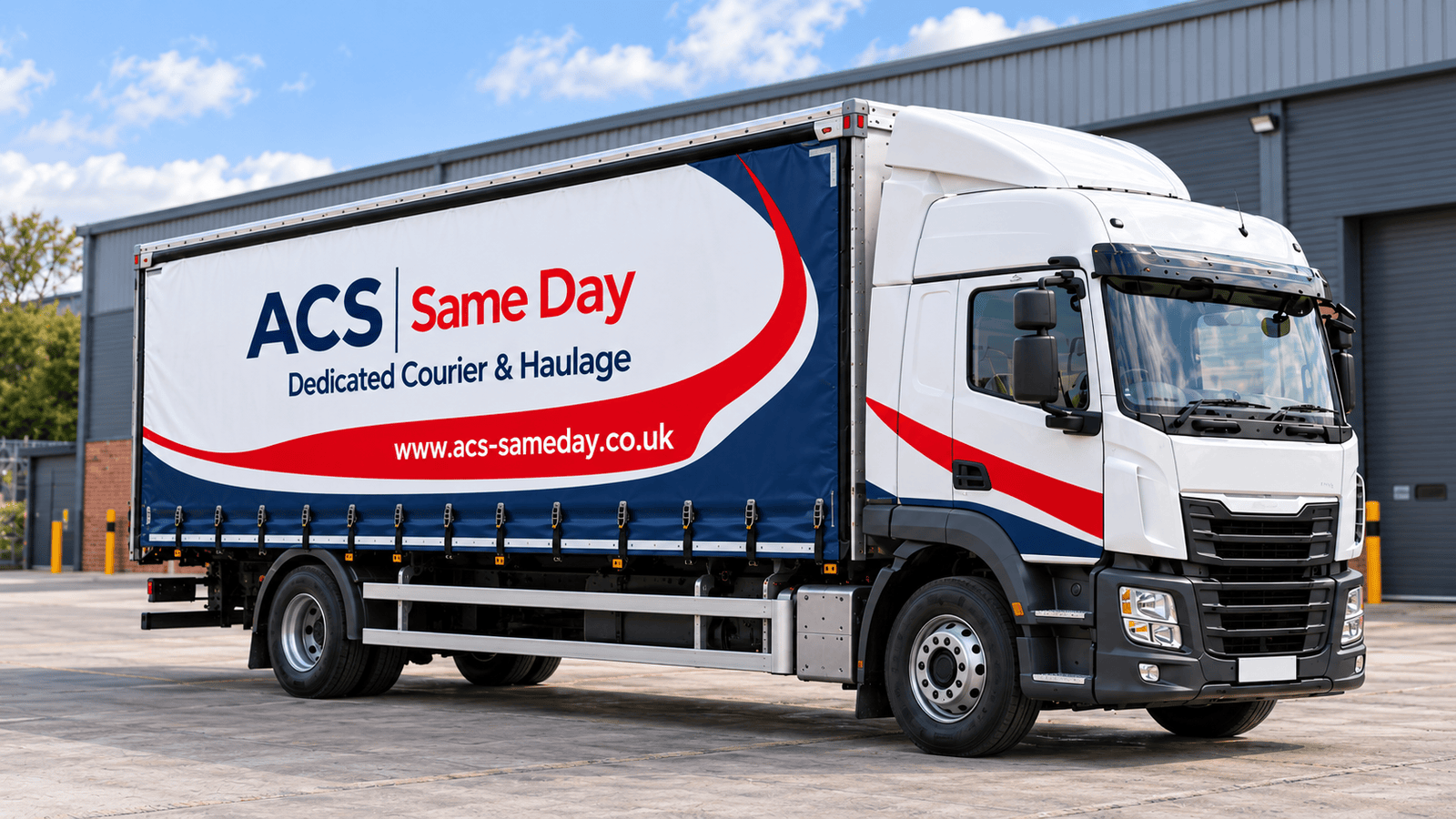
Need a lorry for your next delivery?
If you need to move several pallets, a heavy crate or a load that won’t fit in a van, start with the goods and the two sites. You don’t need to know every lorry specification before making an enquiry, but you do need accurate load details and a clear idea of how it will be loaded and unloaded.
ACS arranges dedicated HGV transport across the UK. We quote these jobs individually, whether you need a planned stock transfer, an urgent collection or deliveries to several addresses. Here’s what to confirm before requesting a price.
Tell us what needs to move
Send a description of the goods, the number of pallets or items, their loaded dimensions and their weights. Include packaging, pallets and any parts that extend beyond the base. For machinery or awkward equipment, photographs can help explain the shape and how it is presented for collection.
Let us know if the goods must stay upright, cannot be stacked or need a particular loading method. If several items are going together, provide the individual details as well as the total weight. A pallet count alone won’t tell us how much floor space the load needs or whether it is within the vehicle’s carrying capacity.
If the supplier is preparing the goods, ask them for the final figures. It’s much easier to arrange the right vehicle before dispatch than to deal with an extra pallet or a taller crate when the driver arrives.
Choose a lorry that suits both the load and the site
Our HGV quote form covers 7.5-tonne and 18-tonne rigid curtainsiders, plus 13.6-metre articulated curtainsiders. A rigid lorry has its cab and load body on one chassis; an artic has a tractor unit and a separate trailer. Which suits your job depends on the load and the space available at both addresses.
The vehicle’s weight category isn’t its payload. A 7.5-tonne lorry, for example, cannot carry 7.5 tonnes of goods. Check the load-space and payload guides on our fleet page, and speak to us if you’re unsure which option to select.
Body type matters too. Tell us whether loading needs to take place from the side or rear. If you need a box body, crane-equipped vehicle, truck-mounted forklift or another specialist arrangement, call before submitting a standard curtainsider request.
Ask the receiving site what it can accept
Before booking an artic, check that the destination can accommodate one. Ask the site contact about the approach, entrance, turning space and unloading position. The fact that a lorry has delivered there before doesn’t tell you which size it was.
Pass on any known height or weight restrictions, narrow access, delivery-hour limits and instructions for reaching the correct gate. A site plan or photograph can be useful where the entrance is difficult to describe.
Some sites also require a booking reference, vehicle details, PPE or a particular FORS level. Include these requirements when requesting the quote, so they can be considered before a vehicle is arranged.
Agree who will load and unload
Loading and unloading are the sender’s and receiver’s responsibility unless agreed otherwise. Confirm what equipment each site has and whether the people needed to operate it will be available at the planned time.
If there’s no forklift at delivery, raise that before booking. A tail lift may be an option on a suitable 7.5T or 18T vehicle, subject to availability and the load and site conditions. Our HGV tail-lift limit is 1,000 kg per pallet or handling unit; total payload limits also apply. The artic option does not include a tail lift.
For heavy machinery or items that need specialist lifting, explain the proposed loading method. Don’t leave the driver and warehouse team to work it out when the lorry arrives.
Be specific about ready times and delivery slots
Give us the time the goods will be ready to load, the collection site’s closing time and the required delivery window. If a booked slot is involved, tell us whether it is confirmed and what the site expects the driver to do on arrival.
A warehouse being open until 18:00 doesn’t necessarily mean it will start unloading a lorry at 17:55. Check the latest arrival time with the receiving team, particularly if unloading takes a while.
For several drops, provide the full route and any required order, with the load and unloading arrangements for each stop. If goods need to arrive early the following morning, say whether loading the previous day is possible. Call us about urgent collections or fixed deadlines so we can discuss availability and the journey before you rely on it.
Flag anything outside a standard load
Tell us about unusual dimensions, temperature requirements, high-value equipment or special handling when you first enquire. For dangerous goods, use the ADR quote form so the shipment can be assessed separately before acceptance.
If the load or instructions change after quotation, contact ACS before collection. More weight, another stop or a different delivery slot can affect the vehicle and the price.
Request your HGV quote
Use our haulage quote form to send the route, dates, load details and vehicle requirements. HGV prices are prepared manually and sent by email.
To proceed, follow the quotation link, complete the remaining details and arrange any required payment or account approval. Sending an enquiry doesn’t reserve a lorry; wait for ACS booking confirmation before treating the transport as booked.
If you need help choosing a vehicle or have an urgent requirement, call 01234 385970 with the load and site details to hand.